
Submitted by John Grove, DO, Angela Verdoni, PhD, DABMGG, Irina Chibisov, MD
Case Presentation
A 62-year-old female presented with a concerning palpable mass in her right breast in January 2008. The patient elected to undergo a lumpectomy, which was followed by a right modified radical mastectomy and axillary lymph node dissection. The right breast mastectomy was complicated by post-operative bleeding requiring transfusion of 1 unit of packed red blood cells (ISTH-BAT score 4). The patient’s past medical history was significant for easy bruising (ISTH-BAT score 1), frequent nosebleeds (ISTH-BAT score 1), heavy menstrual periods (ISTH-BAT score 1) and a history of a hematoma of the left thigh following an injury (ISTH-BAT score 1). The patient’s total ISTH bleeding score was 8 (normal range is <4 in adult males, <6 in adult females and <3 in children).
Her family history was significant for easy bruising and frequent nosebleeds in her mother. The patient had no siblings or children. The only medication the patient was taking was levothyroxine (Synthroid) and her TSH was normal. She was not taking antiplatelet medication or over the counter medications.
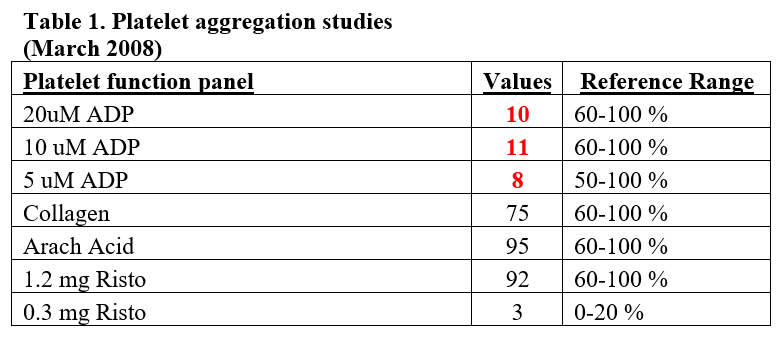
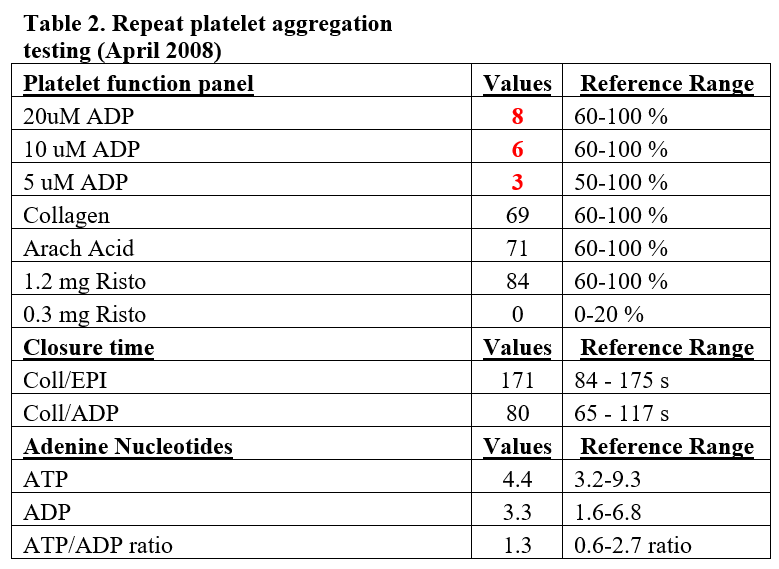
Due to her history of increased mucocutaneous bleeding symptoms, perioperative bleeding requiring blood transfusion, high ISTH bleeding score and family history she underwent laboratory testing in March 2008 which included a CBC with platelet count, peripheral blood film, prothrombin time (PT), activated partial thromboplastin time (aPTT), von Willebrand profile and closure times with collagen/ADP and collagen/EPI, all of which were normal. Platelet aggregation studies by light transmittance aggregometry on platelet rich plasma were abnormal with ADP only (Table 1). Repeat platelet aggregation studies in April 2008 (Table 2) demonstrated persistent abnormalities on platelet aggregation studies with ADP only, but adenine nucleotide testing for delta-storage pool deficiency was normal. Following persistent abnormalities on platelet aggregation studies, the diagnosis of a platelet function defect was rendered, however whether the disorder was inherited or acquired was not discernible. She had no spontaneous bleeding and was not planning any surgeries. She was recommended to be reevaluated prior to surgeries in the future.
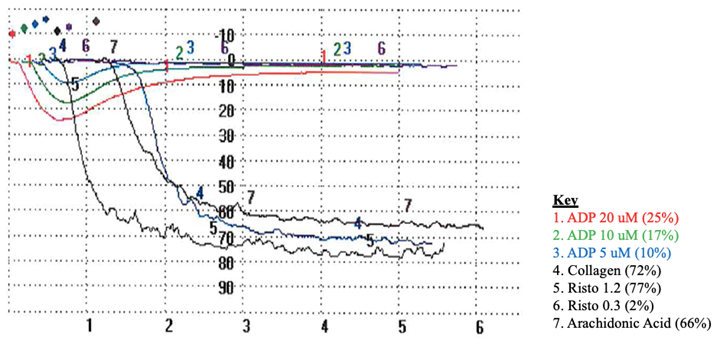
In January of 2024, the patient returned for care with an anticipated fistulectomy and hip replacement in the future. Her previously diagnosed hypothyroidism was well controlled, and she denied any episodes of spontaneous bleeding. Of note, the patient underwent an incision and drainage for a perianal abscess and recovered successfully without any post-operative bleeding complications. Due to her anticipated need of multiple surgical procedures and her history of qualitative platelet dysfunction, she was referred to hematology. Repeat platelet aggregation study results were similar to those previously done in 2008 with decreased platelet aggregation response to ADP only (Figure 1) and adenine nucleotide ratio was again normal. Patient samples were sent for platelet granule storage and release testing by flow cytometry (Table 3).
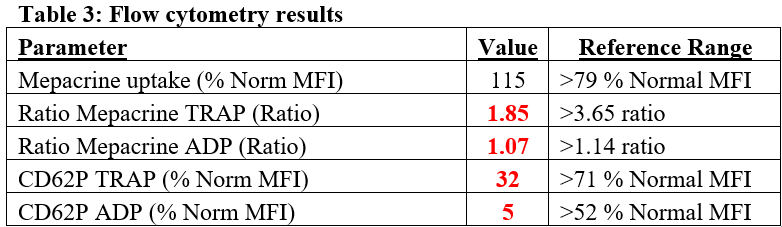
Interpretation Comment: Platelet granule storage and release test by flow cytometry demonstrated significantly decreased both delta and alpha granule release upon stimulation with thrombin receptor agonist (decreased mepacrine TRAP ratio and decreased CD62P TRAP %) and adenosine diphosphate (decreased mepacrine ADP ratio and decreased CD62P ADP %). Delta granule adenine nucleotide storage was normal when tested by mepacrine uptake. However, this assay could not distinguish between alpha granule storage or release defects.