
Welcome to the Digital Pathology Research Center (DPRC). The DPRC is a pioneering hub that serves to advance pathology through ground-breaking discoveries. Our mission, led by Matthew Hanna, MD, is to drive innovation in digital and computational pathology that not only enhance research, but also translate seamlessly into clinical practice, providing novel patient care delivery mechanisms and enhanced workflow efficiency. We invite you to explore the vast opportunities for collaboration and innovation with us.
At the DPRC, we recognize the power of collaborative efforts in accelerating breakthroughs in digital pathology. We actively seek partnerships with other academic centers, industry leaders, technology companies, government bodies, and research institutions to co-develop and refine state-of-the-art digital pathology solutions. By working together, we aim to leverage our collective expertise to push the boundaries of pathology.
Our center has a core focus for participating in clinical trials focused on evaluating, validating and integrating novel digital pathology technologies. We have a streamlined onboarding process in conjunction with the Office of Collaborative Pathology headed by Dr Rajiv Dhir and John Moretti. Where professional staff to assist in authorizing timely contract agreements, project management, as well as IRB and ethics approval. The DPRC has the capacity and capability to readily participate in new methodologies, hardware devices, software applications, AI systems and other innovative tools applied to real-world clinical, trial and/or research settings. Having the impressive resources of UPMC/Pitt allows the DPRC to participate in partnership or studies, including clinical trials that help drive the evolution of pathology practice.
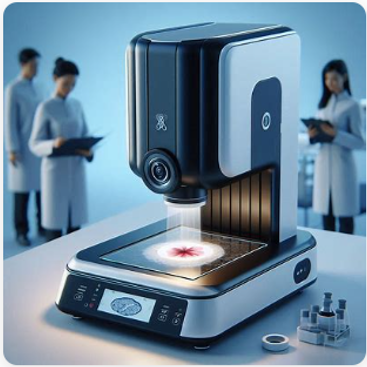 The DPRC is designed to house, operate, and if necessary, compare a comprehensive array of whole slide scanners and other advanced imaging hardware, enabling thorough evaluations, trailblazing studies, standards development, and benchmarking. Our state-of-the-art equipment allows for rigorous testing and comparison of various technologies, ensuring that hardware solution performance is reliable, safe, and validate for clinical use. Our facilities are equipped to handle the latest advancements in scanning and imaging technology, providing a critical evaluation resource for developers and manufacturers. Our staff are highly skilled analysts with decades of experience scanning using many instruments and adept at digital pathology and image management.
In the DPRC, we specialize in evaluating cutting-edge pathology software, from image analysis algorithms to complex AI-based integrated diagnostic platforms. The DPRC has teamed up with UPMC’s CLIA certified Image Analysis Laboratory headed by Dr Ibrahim Abukhiran, where our evaluation process includes rigorous testing for accuracy, usability, and integration with existing systems, ensuring that software solutions meet the highest standards of performance and reliability.
 At the DPRC, we are dedicated to setting and maintaining the highest standards in digital pathology. Our commitment to excellence extends beyond technological innovation to include rigorous quality control and standardization efforts that ensure the reliability and consistency of digital pathology solutions for the greater community. Our center plays a critical role in developing and advocating for industry benchmarks and best practices. We collaborate with regulatory bodies, standard-setting organizations, and industry leaders to define and uphold standards that enhance the accuracy, reproducibility, and safety of digital pathology technologies. By understanding the current standards landscape and limitations, we aim to ensure that digital pathology tools and processes meet stringent requirements, facilitating their broader adoption and integration into clinical workflows.
Consistency and reliability are essential for the effective use of digital pathology in both research and clinical settings. The DPRC is at the forefront of analyzing batch effects and driving solutions towards histopathology variation. We offer precision testing and can impact manufacturers with our expertise in the field. Our efforts focus on creating reproducible methods and ensuring that digital pathology technologies perform consistently across different platforms and settings.
 Driving standards in digital pathology requires a collaborative approach. We actively engage with the global digital pathology community, participating in conferences, workshops, and collaborative projects to share knowledge, insights, and best practices. By fostering a global dialogue on standards and quality, we contribute to the development of a cohesive framework for digital pathology that benefits the entire field.
 The ultimate goal of our research is to ensure that technological innovations benefit patients directly. The DPRC also collaborates with CPACE, the Computational Pathology and AI Center of Excellence headed by Dr Hooman Rashidi. Our research efforts are meticulously validated and aligned with clinical needs to guarantee that advancements in digital pathology translate into tangible improvements in patient care. We are committed to bridging the gap between research and real-world application, ensuring that new technologies are rigorously tested and validated before being integrated into clinical practice.
 The DPRC works closely with our Computational Pathology and AI Center of Excellence (CPACE) at UPMC/Pitt. The DPRC provides input data using a wide variety of digital files and various formats to develop and test AI models. Together with CPACE, the DPRC is also fashioned to embark on AI-based studies to improve the quality of digital slides.
 Digital pathology has a huge impact on virtual education. Our DPRC has the ability to digitize vast amounts of pathology slides of various sizes, using light and/or fluorescent microscopy, with different cellular materials (e.g. histology, cytology, etc). Scanned whole slide images can be anonymized and used to support any kind of educational work, as well as shared with others (e.g. accessible via PathPresenter), to facilitate remote and interactive learning.
We invite you to join us in our mission to revolutionize digital pathology. Whether you are an industry partner, a clinical researcher, or a technology developer, DPRC offers a dynamic environment for innovation and collaboration. Together, we can advance the field of pathology, enhance diagnostic precision, and ultimately improve patient outcomes.
For more information on how to collaborate with us or to learn about our current research and clinical trial opportunities, please contact us (duboyse@upmc.edu). We also welcome visitors to our DPRC. To tour our facility please contact Michele Viola (violam@upmc.edu).