
Authors: Elan Hahn, MD, and Maedeh Mohebnasab, MD
Date of Publication: November 1, 2025
Clinical History
A woman in her 70s presented with early satiety. She underwent CT imaging, which identified a 3.5 cm vascular pancreatic/duodenal mass. The differential diagnosis included a pancreatic neuroendocrine tumor (PanNET) and a gastrointestinal stromal tumor (GIST). Endoscopic ultrasound demonstrated similar findings and biopsies were taken. The biopsy demonstrated a spindle cell neoplasm, which was positive for CD117, and negative for S100, SMA, and CAM-5.2. A diagnosis of GIST was rendered and molecular testing was performed.
Molecular Testing Results
Molecular analysis was performed using the Oncominev3 targeted next-generation sequencing assay. The following results were obtained:
DNA Mutations
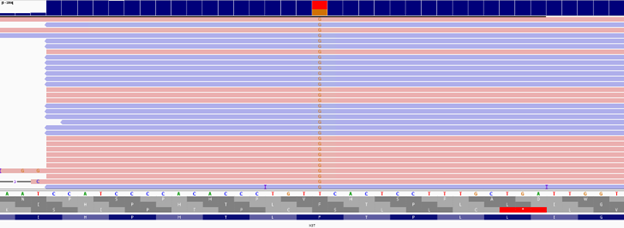
KIT mutation: p.F522C (Exon 10, transmembrane domain)
Copy Number Alterations
Copy number loss at chromosomal regions 1p, 2p/2q, 12p, 15q, and 19p
Interpretation
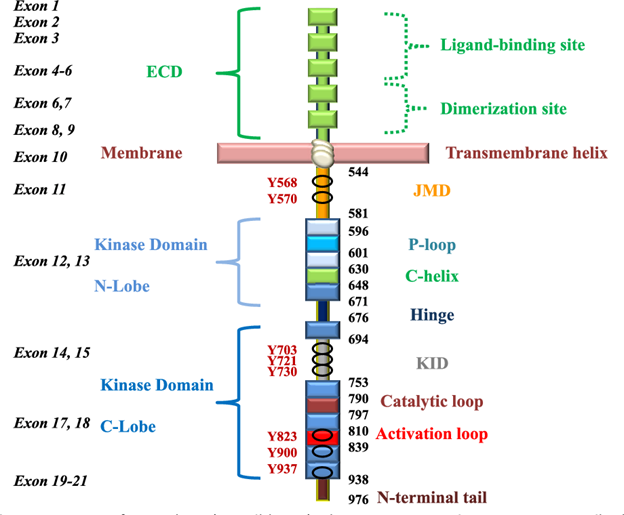
The KIT p.F522C variant represents a rare activating mutation located in exon 10, which encodes the transmembrane domain of the KIT receptor tyrosine kinase (Figure 2). This mutation has been previously described in systemic mastocytosis and shown to cause ligand-independent phosphorylation of KIT, leading to constitutive downstream signaling via the PI3K, JAK/STAT, and MAPK pathways. Importantly, functional studies demonstrate that this activation remains sensitive to treatment with imatinib.
Case Resolution
Given this molecular profile, the patient was started on imatinib therapy, as is standard of care for KIT-mutated GISTs. The presence of multiple chromosomal losses is a well-described phenomenon that does not preclude TKI responsiveness.
Discussion
Gastrointestinal stromal tumors are mesenchymal neoplasms arising from the interstitial cells of Cajal and are common mesenchymal tumors of the gastrointestinal tract. The majority harbor activating mutations in the KIT or PDGFRA genes, which lead to constitutive activation of receptor tyrosine kinase signaling and downstream proliferative pathways. The mutational profile of KIT has critical diagnostic, prognostic, and therapeutic implications.
KIT Mutation Landscape and Clinical Significance
Mutations most frequently occur in KIT exon 11 (juxtamembrane domain), followed by exon 9 (extracellular domain), while exons 13 and 17 (kinase domain) are less common and often associated with resistance to first-line therapy. Exon 10 mutations, such as the p.F522C in our case, are exceedingly rare, but biologically relevant. Functional data in a case of mastocytosis harboring this mutation showed that it is activating, leading to increased protein phosphorylation in the absence of ligand binding1. Decreased protein activation and cell viability was observed with imatinib treatment1. Subsequent work by Broderick et al. (Leukemia Research, 2019) further confirmed the KIT p.F522C mutation as being sensitive to treatment with imatinib, demonstrating sustained response by decreasing serum tryptase and F522C allele burden as measured by digital droplet PCR2.
Imatinib remains the standard of care for patients with unresectable, metastatic, or high-risk KIT-mutated GISTs3-6. NCCN guidelines recommend mutation-guided therapy, as response rates and progression-free survival differ substantially among mutational subtypes6. KIT exon 11 mutations confer high sensitivity to imatinib, whereas exon 9 mutations may require higher dosing, and exon 13/17 mutations are typically detected as secondary resistance mutations and may benefit from second-line agents such as sunitinib, regorafenib, or ripretinib6.
References
- Akin C, Fumo G, Yavuz AS, Lipsky PE, Neckers L, Metcalfe DD. A novel form of mastocytosis associated with a transmembrane c-kit mutation and response to imatinib. Blood. 2004 Apr 15;103(8):3222–5.
- Broderick V, Waghorne K, Langabeer SE, Jeffers M, Cross NCP, Hayden PJ. Molecular response to imatinib in KIT F522C-mutated systemic mastocytosis. Leuk Res. 2019 Mar;77:28–9.
- Heinrich MC, Corless CL, Demetri GD, Blanke CD, von Mehren M, Joensuu H, et al. Kinase mutations and imatinib response in metastatic gastrointestinal stromal tumor. J Clin Oncol. 2023 Oct 20;41(31):4829–36.
- Corless CL, Fletcher JA, Heinrich MC. Biology of gastrointestinal stromal tumors. J Clin Oncol. 2004 Sep 15;22(18):3813–25.
- Lasota J, Miettinen M. Clinical significance of oncogenic KIT and PDGFRA mutations in gastrointestinal stromal tumours. Histopathology. 2008 Sep;53(3):245–66.
- National Comprehensive Cancer Network. Gastrointestinal Stromal Tumors (GIST) [Internet]. Version 2025.1. Plymouth Meeting (PA): NCCN; 2025 Apr 17 [cited 2025 Oct 23]. Available from: https://www.nccn.org/professionals/physician_gls/pdf/gist.pdf
- Bibi S, Langenfeld F, Jeanningros S, Brenet F, Soucie E, Hermine O, Damaj G, Dubreuil P, Arock M. Molecular defects in mastocytosis: KIT and beyond KIT. Immunol Allergy Clin North Am. 2014 May;34(2):239-62.