Authors: Wenli Dai, MD, PhD and Dr. Esther Elishaev, MD
Case Presentation
A female kidney transplant patient in her 70s presented for cold knife cone excision of adenocarcinoma in situ (AIS) and low grade squamous intraepithelial lesion (LSIL) found on endocervical curettage (ECC) and cervical biopsy respectively.
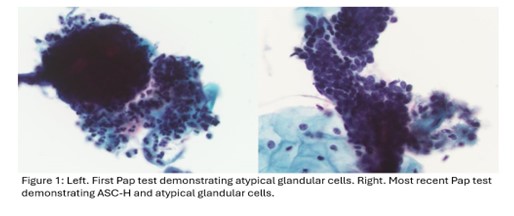
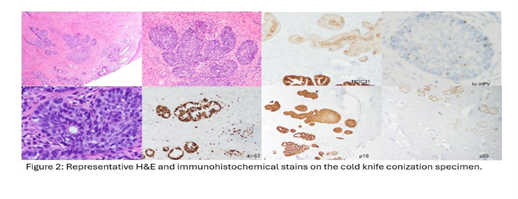
Her past cervical screening Pap test history was significant for continuous high-risk human papilloma virus (HR-HPV) positive results with either atypical squamous cells of undetermined significance (ASCUS) or LSIL findings starting 10 years ago with follow-up cervical biopsies showing the presence of low-grade squamous intraepithelial lesion (LSIL/CIN-1). The initial Pap test with atypical glandular cells (AGC) diagnosis was established in 2020, followed by AGC /ASC-H (atypical squamous cells, cannot rule out high grade squamous intraepithelial lesion) Pap test findings in 2023 and LSIL/ASC-H diagnosis in 2025. (Figure 1: representative image of AGC, ASC-H Pap test results from 2023). No cervical assessments or follow-up with sampling are documented in our files over this 5-year time frame. (It is plausible that COVID lockdown was partially responsible for the lack of follow-up. Preoperative workup included transvaginal ultrasound which demonstrated a leiomyomatous uterus, but otherwise no other significant findings. Gynecologic examination revealed uterovaginal prolapse and evaluation of cervical mucosa intraoperatively demonstrated a 1 cm glandular flat lesion at 6 -7 o'clock. The remainder of the cervical and vaginal mucosa were unremarkable. A cold knife cone procedure yielded a 2 cm in diameter and 1.7 cm in length cervical “doughnut" specimen which was submitted in its entirety for histologic examination. (Figure 2: Representative section of invasive tumor, H&E and immunohistochemical stains).