
Authors: Emily W. Gripp, MD; Suzanne Bakdash, MD, MPH
Date of Publication: September 1, 2026
Case Presentation
A patient in their 50s with a history including hepatic cirrhosis secondary to alcohol use initially presented with deep vein thrombosis after SARS-CoV-2 infection. They underwent hypercoagulability work up at the time of presentation (Table 1).
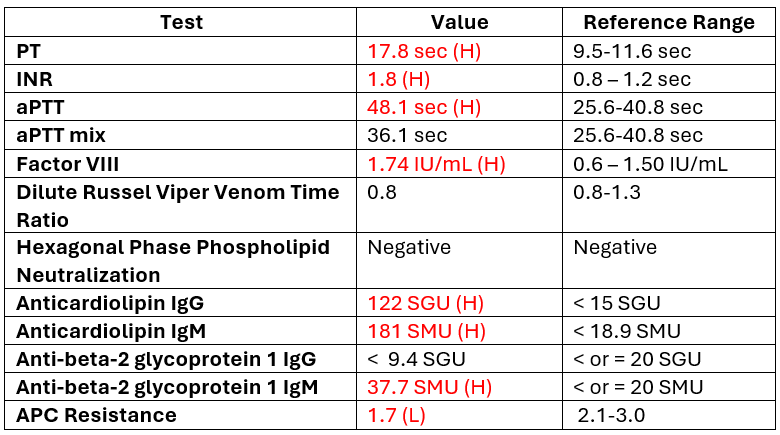
The prothrombin time (PT) and international normalized ratio (INR) were elevated, as was the activated partial thromboplastin time (aPTT). The aPTT corrected on a 1:1 mix with normal plasma, suggesting a factor deficiency rather than an inhibitor. In the setting of liver cirrhosis, these findings were attributed to impaired hepatic synthetic function, resulting in reduced production of coagulation factors. Because the patient had a history of cirrhosis, protein C, protein S and thrombin were not evaluated.
A lupus anticoagulant panel was negative. However, testing revealed the presence of anticardiolipin antibodies (IgG and IgM) and anti-beta-2 glycoprotein 1 IgM. Because these antibodies can be transient in the setting of an acute event, testing was repeated 12 months later and the patient no longer had detectable anticardiolipin or anti-beta-2 glycoprotein 1 antibodies.
Finally, this patient’s activated protein C resistance (APC-R) assay was low. APC-R testing is a functional screen for Factor V Leiden. The low APC-R testing prompted germline genetic testing for the Factor V Leiden mutation from peripheral blood. Testing with quantitative PCR demonstrated a heterozygous R506Q variant in the F5 gene.
The patient was diagnosed with Factor V Leiden and coagulopathy related to liver cirrhosis. An inferior vena cava (IVC) filter was placed. The patient was started on intermediate dose enoxaparin with removal of the IVC filter after 6 months. Because the DVT was considered unprovoked and Factor V Leiden put the patient at higher risk of future clotting episodes, anticoagulation was planned to be continued indefinitely.
Four years later, an APC-R assay was again ordered. The APC-R was normal on initial and repeat testing of the same sample (Table 2). The normal APC-R in this patient with known Factor V Leiden and historically decreased APC-R prompted further investigation.
