
Diagnosis
Anti-PP1Pk alloimmunization in pregnancy.
Discussion
The PP1Pk blood group system is a rare, clinically significant antigen group comprising P, P1, and Pk antigens. Individuals lacking these antigens exhibit the p phenotype, which occurs in approximately 5.8 per million individuals globally, with higher prevalence in certain populations such as the Amish [1-3,7]. The absence of these antigens leads to the natural formation of anti-PP1Pk antibodies, which are strongly associated with recurrent pregnancy loss and hemolytic transfusion reactions [1,3]. Individuals with the p phenotype carry inactivating mutations in the A4GALT1 gene located on chromosome 22q13.2. This gene encodes 4-α-galactosyltransferase, an enzyme responsible for converting lactosylceramide into glycosphingolipids. Loss of this function prevents the synthesis of P, P1, and Pk antigens which are chemically glycosphingolipids (Figure 2) (1,2). Recent studies also identified a missense mutation in the A4GALT gene in Amish p phenotype individuals (2). P and Pk antigens are widely expressed in placental tissue and P1 antigen in fetal RBC, explaining their role in pregnancy-related complications [2,4]. Anti-PP1Pk antibodies are typically a mixture of IgM and IgG, with IgG3 being the predominant cytotoxic subclass capable of crossing the placenta and activating complement [1].
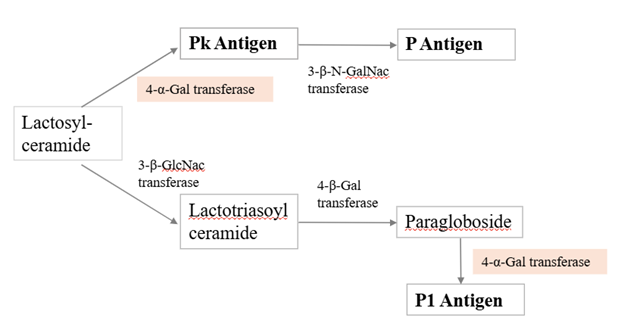
The P, P1, and Pk antigens also function as receptors for various infectious agents. All three can serve as binding sites for uropathogenic Escherichia coli. The P antigen specifically acts as the receptor for parvovirus B19, which causes erythema infectiosum and may lead to transient aplastic anemia. The Pk antigen is a receptor for Shiga toxins. Interestingly, recent studies suggest that Pk expression is associated with reduced susceptibility to HIV-1 infection, whereas individuals with the p phenotype exhibit increased vulnerability (2).
The presence of anti-PP1Pk antibodies in women of reproductive age is associated with a 50–70% risk of miscarriage, reaching up to 87% in the second trimester [1,3]. The mechanism involves antibody-mediated placental injury rather than fetal hemolysis, as P and Pk antigens are highly expressed on trophoblasts from 3–5 weeks of gestation while the P1 antigen starts to appear from the 19th week [1,3]. Hemolytic disease of the fetus and newborn is rare but documented [2]. Additionally, these antibodies can cause severe hemolytic transfusion reactions due to their broad reactivity with common antigens, making compatible blood extremely difficult to source [2,5]. There is no standardized protocol for managing pregnancies complicated by anti-PP1Pk alloimmunization; however, reported strategies include early initiation of therapeutic plasmapheresis to reduce antibody titers to ≤1:32, sometimes requiring up to 50–60 sessions during pregnancy [4,6,7]. Immunomodulatory approaches such as corticosteroids and low-molecular-weight heparin (LMWH) have been used for their anti-inflammatory and immunosuppressive effects, though evidence remains limited [1]. Combined intravenous immunoglobulin (IVIG) and plasma exchange therapy has shown promise in maintaining low titers and preventing rebound antibody synthesis [4]. Given the scarcity of compatible donors, autologous blood collection during pregnancy or preconception is recommended for anticipated transfusion needs [5] and enrollment in rare donor registries with family phenotyping is essential for emergency transfusion planning [3].
The rarity of the p phenotype and anti-PP1Pk alloimmunization limits the availability of high-quality evidence. Most recommendations are based on case reports and small series, with slight variability in treatment regimens and outcomes. Case reports demonstrate successful outcomes when multidisciplinary care is implemented early, including frequent antibody titration, fetal monitoring via middle cerebral artery doppler, and planned delivery with blood availability [3,4,6]. Establishing national registries and standardized titration protocols could improve management and facilitate research. Further studies are needed to clarify critical titer thresholds and the role of adjunct therapies such as IVIG [4]. In addition, ongoing research on neonatal immunoglobulin Fc receptor blockers, such as Nipocalimab, highlights their ability to lower maternal IgG levels by inhibiting IgG recycling and transplacental transfer, offering new therapeutic options for managing alloimmune pregnancy complications (8).
Conclusion
The PP1Pk blood group system, though rare, presents significant challenges in transfusion medicine and obstetric care. Anti-PP1Pk antibodies are strongly associated with recurrent miscarriage and hemolytic transfusion reactions. Early identification, multidisciplinary management, and individualized therapeutic strategies including plasmapheresis, immunomodulation, and autologous blood donation are essential to optimize maternal and fetal outcomes. Future efforts should prioritize establishing comprehensive registries and developing consensus-based guidelines to standardize care for this high-risk population, while also exploring innovative treatment strategies.
References
- Nascimento S, Rodrigues M, Henriques MG, Duarte FP, Barra A, Matos T, et al. Pregnancy with anti‑PP1Pk antibody managed with prednisolone and low‑molecular‑weight heparin: a case report and literature review. Case Rep Womens Health. 2020;27:e00238.
- Benidt GR, Jaben EA, Winters JL, Stubbs JR. Identification of anti‑PP1Pk in a blood donor and her family: a case report following her pregnancy and review. Transfus Apher Sci. 2010;43(3):369–74.
- Bonmatí‑Santané A, Céspedes López R, Alvarez Saltos JJ, Calabia Martínez J, Noboa Paez C, Piedra Sánchez J, et al. Managing a pregnancy in the presence of the rare blood group antibody PP1Pk. Womens Health Rep. 2024;5(1):319–23.
- Hadjiyannis Y, Jones JM, Chibisov I, Kiss J, Gabert K, Sevcik J, et al. Successful management of maternal anti‑PP1Pk alloimmunization in pregnancy with therapeutic plasma exchange and intravenous immunoglobulin. J Clin Apher. 2024;39(3):e22120.
- Pacheco MC, Fedda F, Mignogna D, Meena‑Leist C. Bleeding patient with anti‑PP1Pk – revisiting autologous frozen red blood cells [abstract]. Am J Clin Pathol. 2021;156(Suppl_1):S156.
- Taniguchi F, Horie S, Tsukihara S, Nagata N, Nishikawa K, Terakawa N. Successful management of a P‑incompatible pregnancy using double filtration plasmapheresis. Gynecol Obstet Invest. 2003;56(2):117–20.
- Hanafusa N, Noiri E, Yamashita T, Kondo Y, Suzuki M, Watanabe Y, et al. Successful treatment by double‑filtrate plasmapheresis in a pregnant woman with the rare P blood group and a history of multiple early miscarriages. Ther Apher Dial. 2006;10(6):498–503.
- Moise KJ Jr, Ling LE, Oepkes D, Tiblad E, Verweij EJ, Lopriore E, et al. Nipocalimab in early‑onset severe hemolytic disease of the fetus and newborn. N Engl J Med. 2024;391(6):526–37.