
Authors: Kyle Damen DO and Steven Dobrowolski PhD
Publish Year: 2024
Clinical History
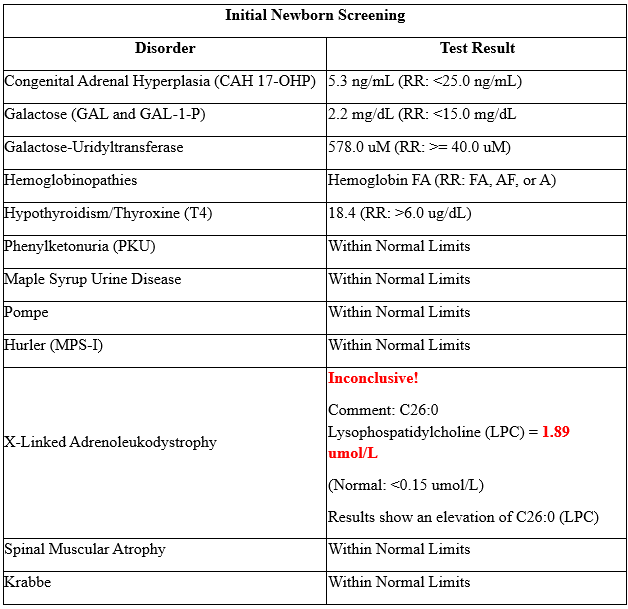
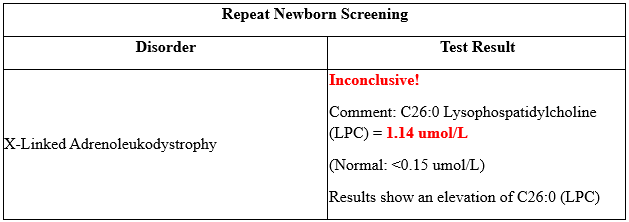
A newborn girl was referred to medical genetics following an abnormal initial and repeat Pennsylvania newborn screening panel.
The patient was delivered at 41 and 2/7 weeks by cesarean section following a failure in labor progression. Delivery was uncomplicated and APGAR scores were 8 and 9. The mother had appropriate prenatal care, and the antenatal period was notable for discovery of a fetal cystic hygroma and fetal echogenic bowel at the 12-week ultrasound. Chorionic villus sampling revealed no evidence of trisomies on FISH analysis (46 XX) and initial CMV testing was declined.
Physical exam following birth was notable for microcephaly (OFC <1 percentile), bilateral single palmar creases, small mouth, prominent eyes with widely spaced and flat nasal bridge, an open sagittal suture palpable between fontanels, anterior tongue tie and a sacral dimple with hair tufting. The ultrasound of the spine was normal. Of note the patient failed the newborn hearing screen; follow up cytomegalovirus (CMV) DNA testing by qualitative PCR was negative.
Testing
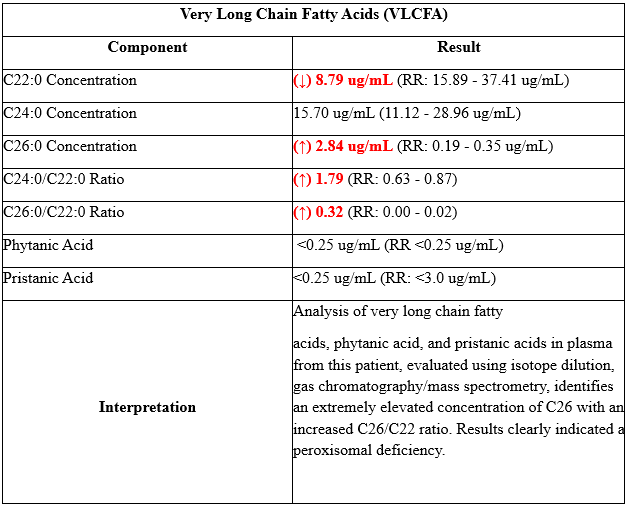
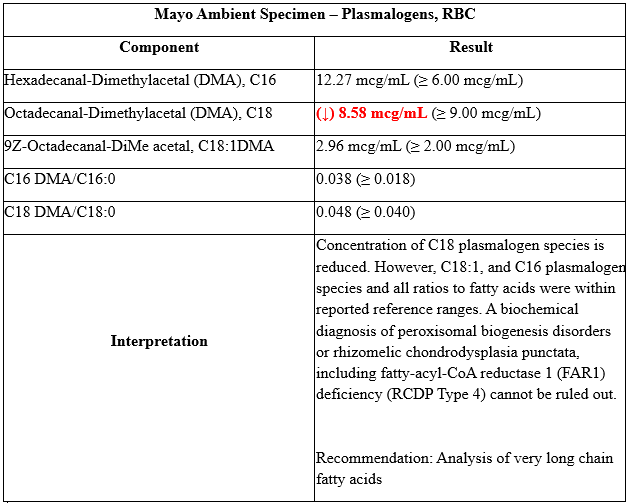
Whole blood was sent for a custom peroxisomal molecular panel analyzing the following genes: ABCD1, ABCD3, ACBD5, ACOX1, ADAR, AGPS, AGXT, AMACR, BCAP31, CAT, DNM1L, GNPAT, HSD17B4, IFIH1, PEX1, PEX10, PEX11B, PEX12, PEX13, PEX14, PEX16, PEX19, PEX2, PEX26, PEX3, PEX5, PEX6, PEX7, PHYH, RNASEH2A, RNASEH2B, RNASEH2C, SAMHD1, SCP2, TREX1, and TRIM37.
The patient was found to be heterozygous in PEX1 for two in trans sequence variants including c.2528G>A and c.3655C>T. The first is known to be pathogenic and the second is considered likely pathogenic. An additional variant in ACOX1 was identified and considered less likely to be a primary cause of disease.